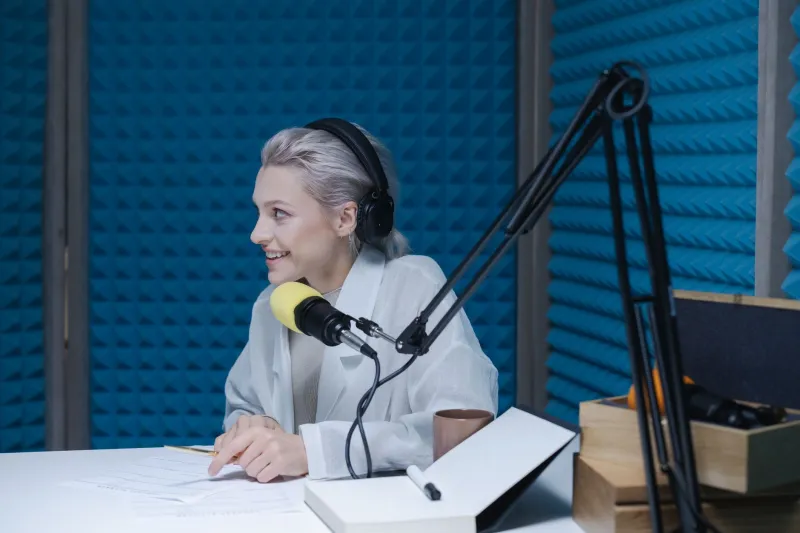
Fifteen Minutes of Fame (Every Single Day): How Bite-Sized Live Streams Are Winning Over Burned-Out Binge Watchers

Somewhere between the third episode of a prestige drama and the moment you realize it's 1:30 AM on a Tuesday, binge culture quietly broke its own promise. It sold us freedom — watch what you want, when you want — and then promptly ate six hours of our weekend. For a growing slice of American viewers, the antidote isn't another platform or another algorithm. It's a live stream that runs for exactly 15 minutes and ends before your lunch break does.
Welcome to what we've started calling the Matinee Effect.
What the Matinee Effect Actually Looks Like
Picture this: it's 12:10 PM, you've got half a sandwich and about 20 minutes before your next Zoom. You flip open a tab, catch a live acoustic performance from a singer-songwriter in Nashville, drop a comment, get a shoutout, and close the laptop feeling genuinely refreshed. No cliffhanger. No guilt. Just a clean, contained moment of entertainment that actually fit your life.
That's the Matinee Effect in action. Short, scheduled, live content — think interview segments, mini-performances, rapid-fire Q&As, cooking demos, comedy sets — that arrives on a predictable schedule and wraps up before anyone has time to feel overwhelmed. It's appointment viewing reimagined for people who stopped making appointments.
And the data is starting to back this up in a real way. Streaming analytics firms tracking mid-day content consumption have noted a significant uptick in what they call "micro-session engagement" — viewers who tune in for under 20 minutes but return daily, sometimes multiple times a day. Retention rates for these short live windows are, counterintuitively, outperforming longer-form content in the same daytime slots.
Why Our Brains Are Done With the Binge
There's a psychological dimension here that's worth sitting with. Binge-watching, for all its pleasures, operates on a scarcity-and-reward loop that's increasingly exhausting. You're always chasing the next episode, the next reveal, the next reason to keep going. It's entertainment as an endurance sport.
Short live content flips that script entirely. The segment ends. You got what you came for. There's a completeness to it that longer content rarely offers. Psychologists who study habit formation call this a "closed loop" — a behavior that has a clear beginning, middle, and end, making it far easier to integrate into daily routines without the associated guilt of over-consumption.
For time-strapped Americans — parents, remote workers, people commuting on the subway, folks eating alone in office break rooms — that closed loop is incredibly appealing. You're not committing to anything. You're just showing up, like you would for a favorite radio segment or a morning podcast drop. Except this is live, which changes everything.
The Live Part Is the Whole Point
Here's where it gets interesting. Pre-recorded short-form content — your YouTube Shorts, your TikTok clips — is everywhere. The market is absolutely saturated. So why are people choosing to tune into live 15-minute windows instead of just watching something on demand?
The answer is community, and it's more powerful than most people in the industry expected.
When something is live, the chat is live. The reactions are live. If a performer flubs a lyric or a host laughs at the wrong moment, everyone watching sees it simultaneously. That shared, unrepeatable experience creates a kind of social glue that replays simply cannot manufacture. Viewers aren't just watching — they're witnessing something together, and that distinction matters enormously to engagement.
Platforms hosting daytime live content have reported that comment activity during 15-minute live slots rivals — and sometimes exceeds — the chat volume during hour-long live events. Shorter windows concentrate the energy. Everyone knows the clock is running, so participation spikes.
Building the Daily Habit Loop
What makes the Matinee Effect genuinely transformative for the entertainment industry isn't just the format — it's the rhythm. Successful short-form live shows aren't one-offs. They run Monday through Friday, same time, same vibe, slight variations. That consistency trains audiences the same way a morning coffee ritual does. You don't decide whether to do it. You just do it.
Creators and producers who've cracked this code talk about it almost like publishing a daily newsletter. The content itself matters, but the schedule is the product. When your audience knows that at 12:15 PM EST, something worth watching is going to happen for exactly 15 minutes, they build their lunch break around it. That's an extraordinary amount of behavioral real estate to occupy in someone's day.
For brands paying attention — and increasingly, they are — this daily habit loop is a marketing goldmine. A viewer who shows up voluntarily, every day, for a live segment they genuinely enjoy is infinitely more valuable than someone who half-watches a pre-roll ad during a passive scroll session.
The Format Is Still Being Invented
One of the most exciting things about the 15-minute live segment is how young the format still is. Producers are experimenting wildly. Some are running live trivia with audience prizes. Others are doing rapid-fire celebrity interviews where viewers vote on questions in real time. There are chefs cooking entire dishes from scratch in 12 minutes while chatting with their audience, musicians performing one song and then spending the remaining time just talking to the people watching.
None of this has hardened into convention yet, which means the creative ceiling is genuinely high. We're essentially watching a new genre get built in real time — and the daytime window is where most of that experimentation is happening, precisely because the stakes feel lower and the audience is more forgiving and participatory.
What This Means for You
If you haven't tried building a midday live stream into your daily routine, this is your nudge. The entry point is low, the time commitment is minimal, and the payoff — a genuine moment of entertainment, connection, and community in the middle of your workday — is surprisingly high.
The binge isn't going anywhere. But for the hours between 11 AM and 3 PM, when your brain needs a reset and your schedule won't allow a rabbit hole, the 15-minute live moment might just be the most satisfying thing on your screen. Not because it's epic. Because it's exactly enough.